
Please Choose Your Language


Views: 0 Author: Site Editor Publish Time: 2026-09-14 Origin: Site


A capped board can simplify the management of spills and surface appearance, but it does not automatically make a deck stronger or suitable for a wider support spacing. When comparing capped vs uncapped composite decking, buyers should separate surface protection from the board's core, profile, and installation requirements. The most useful choice is the construction that matches the actual exposure and maintenance plan. It should also have evidence for the intended walking application, rather than borrowing performance from a visually similar fence board, wall panel, or other composite product.
Comparison snapshot: capping adds a distinct outer layer; an uncapped board exposes the composite material itself. Compare staining, colour change, scratching, cleaning, and repair as surface questions. Compare span, loading, fasteners, and support as separate installation questions. Neither label eliminates the need for product-specific evidence.
Uncapped composite decking typically presents its wood-plastic composite formulation directly at the exposed face. A capped product adds an outer layer that can be formulated for surface protection and appearance. This distinction explains why two boards with similar dimensions may respond differently to spills or cleaning. It does not tell the buyer everything about performance, because the composition, manufacturing quality, finish, and profile of each board still matter.
For Co-extrusion deck boards, establish which faces receive the protective layer and how the ends are detailed after cutting. A face-capped board and a more extensively capped board should not be treated as identical constructions. The underside, side grooves, and cut ends may have different exposure conditions in the finished deck. Compare the actual section and installation detail rather than interpreting the word capped as complete protection of every part.
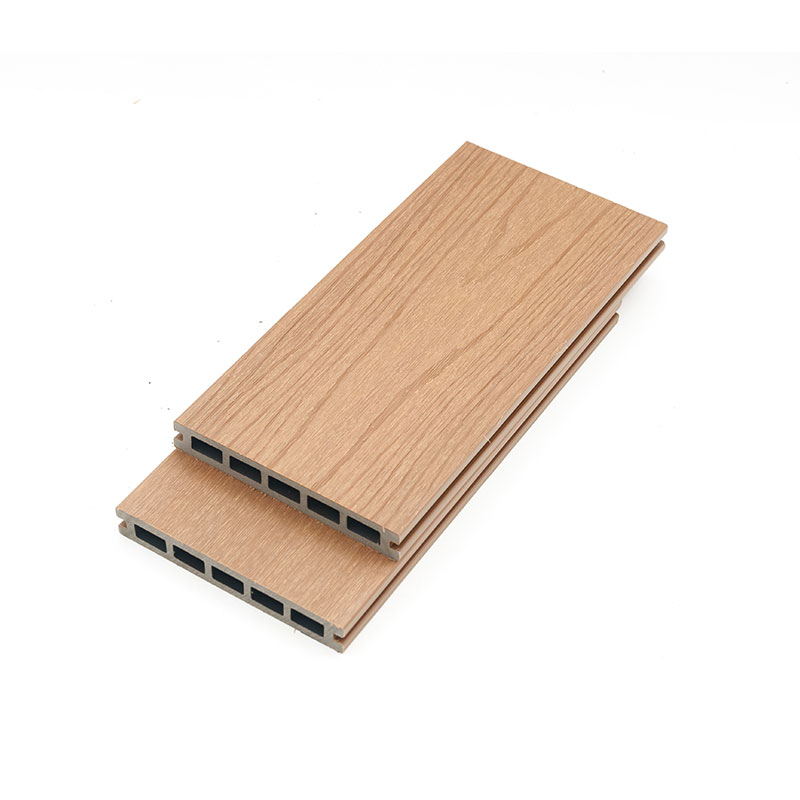
Hollow co-extrusion decking sample used to examine the exposed face and board section.
Capping and solid construction are also independent features. A board may be hollow or solid and still have a capped or uncapped exposed surface. Colour-mixed solid decking is relevant when comparing solid composite profiles, but its solid section alone does not prove a particular cap arrangement. Ask for both pieces of information explicitly so the quotation cannot hide a surface difference behind a structural description or a structural difference behind a finish description.
Decision factor | Capped decking | Uncapped decking | What to verify |
|---|---|---|---|
Exposed surface | Separate outer layer | Composite formulation directly exposed | Which faces are protected and what finish is supplied |
Spill management | Cap may limit direct contact with the core | Response depends on exposed formulation | Product-specific stain testing and cleaning guidance |
Colour change | Depends on cap and pigments | Depends on exposed composite and pigments | Weathering results for the exact colour |
Scratch repair | Removing the cap can worsen damage | Some products permit controlled surface repair | Written instructions for the exact board |
Structural suitability | Not established by capping | Not established by absence of capping | Rated span, load conditions, and installation system |
Maintenance cost | Potentially simpler surface care | May require different appearance management | Real cleaning schedule and repair limits |
A cap can provide a barrier between everyday spills and the composite core, which may make cleaning more straightforward when the product is correctly specified. However, stain performance still depends on the liquid, contact time, temperature, and cleaning method. Cooking oil, food colouring, sunscreen, and mineral-laden water are different exposures. A broad stain-resistant statement should be supported by evidence relevant to the terrace's actual use rather than a single favourable demonstration.
Uncapped decking should not be dismissed as unsuitable for all outdoor projects. Its performance varies by formulation and finish, and an appropriate product can be evaluated against a realistic maintenance plan. Buyers should ask how quickly spills must be removed and whether particular cleaners are required. A material that works well in a lightly used residential terrace may be less convenient in a restaurant where food spills and chair movement occur throughout the day.
Neither construction turns the deck into a waterproof membrane. Water can pass through joints and reach supports, fixings, and the substrate. Roof terraces, balconies, and pool surroundings therefore require their own drainage and waterproofing design. Assess water management beneath the boards separately from water resistance of the board material. A cap that cleans easily does not remedy blocked outlets, standing water, or an installation that prevents the underside from drying.
A matching outdoor design may include Capped hollow fence boards as well as decking. Their capped surface can be considered when coordinating colours and cleaning expectations, but fence-board performance is not evidence of decking load capacity. Fence assemblies also have their own support and fixing requirements. Use related products to coordinate the visual scheme while retaining independent technical approval for every distinct application in the project.
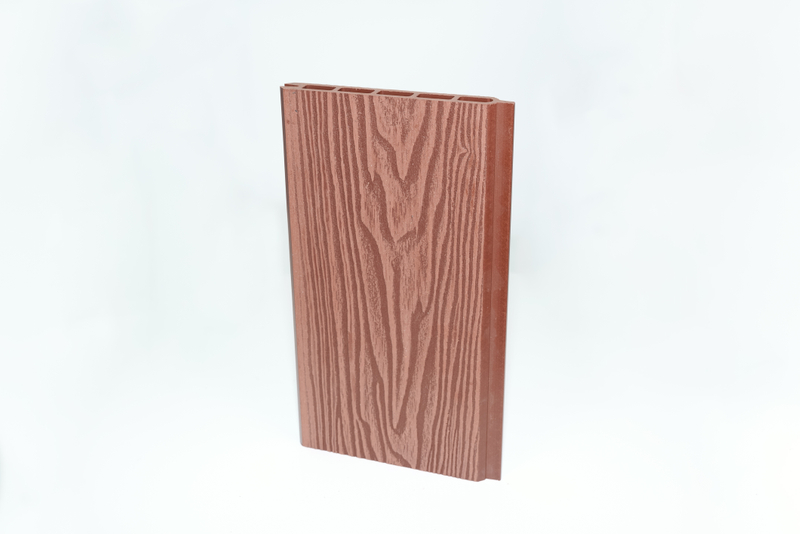
Fluted capped hollow fence board, shown as a related vertical application rather than a deck board.
In capped vs uncapped composite decking comparisons, colour retention should be assessed on the exact finish supplied. A cap may be designed to improve weathering performance, but the result depends on its formulation and pigments. An uncapped board may also change appearance as its exposed surface weathers. Request comparable weathering evidence, then decide what degree and pattern of change is acceptable for the project instead of assuming either category is completely colour-stable.
Scratches require a separate comparison because colour retention and scratch resistance are different responses. A textured mixed-tone finish can hide light marks more effectively than a smooth uniform colour, even without a superior measured resistance. Dark and light finishes may show contrasting marks differently. Inspect scratched samples dry and at realistic viewing distance, and distinguish transferred material from actual removal of the outer layer or composite surface.
Do not rank products only by how impressive a clean showroom sample appears. Include the furniture, footwear, and contamination likely to contact the deck in service. If the terrace connects to a gravel path, particles trapped beneath chair feet may matter more than ordinary foot traffic. A realistic comparison records the object, movement, load, and visible result, providing a repeatable basis for choosing a finish that suits the space.
Similar-looking Capped hollow wall panels can help coordinate a facade with the deck, but its five-hole wall-panel section belongs to a different application. A common colour family does not mean the walking face and wall face have identical durability requirements. Horizontal surfaces face furniture contact, foot traffic, and water collection differently from vertical surfaces. Compare each finished surface using the exposures it will actually experience after installation.
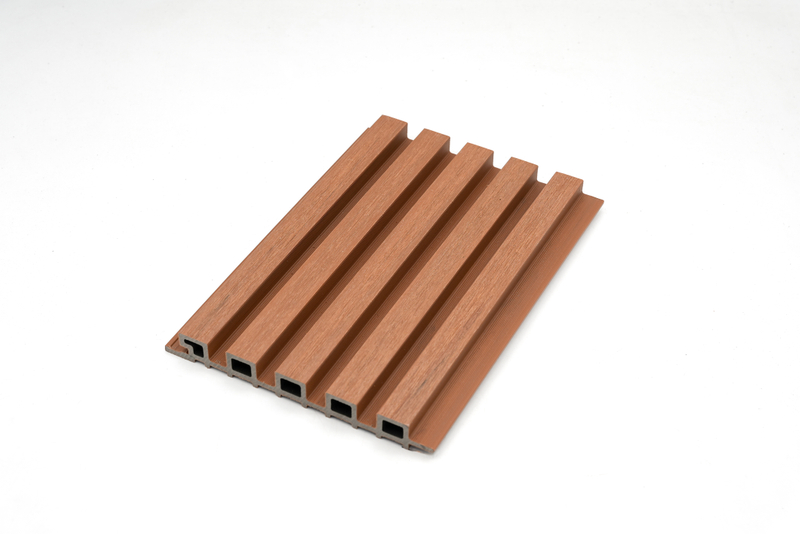
Five-chamber capped wall panel used for a coordinated vertical surface, not walking-surface approval.
Capped decking often encourages a gentle cleaning approach because aggressive abrasion can damage the outer layer. Removing a scratch by sanding may leave a patch with different colour or expose the core beneath. Uncapped boards may permit certain surface treatments, but only where the manufacturer provides suitable instructions. Never transfer a repair method from one construction to another simply because both products are sold under the composite decking category.
Maintenance labour should be considered alongside the initial purchase price. A slightly different cleaning frequency can matter over a large commercial terrace, while replacement access can matter more on a small deck with fixed furniture. Compare the time, approved products, tools, and disruption involved in routine care and damage management. Keep assumptions explicit so a lower board price is not confused with a lower total cost of operating the finished space.
Replacement boards should remain compatible with the fastening system, profile dimensions, and approved finish. Ask whether a damaged board can be removed individually, and retain spare material where appropriate. Surface appearance may vary between new and weathered boards, making a replacement plan relevant to both capped and uncapped choices. Warranty terms should be checked for specific exclusions and maintenance obligations rather than treated as a general promise that every visible change will be covered.
PVC foam capped cladding introduces another material distinction: PVC foam capped cladding is not the same product category as wood-plastic composite decking. It can be relevant to a coordinated wall finish, but its material, profile, and intended use require their own review. Keeping this boundary clear avoids an especially common purchasing error: assuming that the word capped identifies one interchangeable technology across every board used around a building.
Check whether the proposed finish remains compatible with the cleaning supplies already used on the property. A facility operator may have an established routine for stone, tile, or metal that is unsuitable for a polymer cap. Changing the board construction can therefore require a revised maintenance instruction and staff training. Include this transition in the cost comparison, rather than assuming that an existing cleaning procedure transfers unchanged to the new deck.
Compare warranty scope using the same questions for both constructions. Identify whether coverage concerns structural defects, staining, fading, or another defined condition, and note any exclusions for abrasion, improper cleaning, or installation. A longer stated period does not necessarily cover more of the changes that matter to the owner. Match the terms to the selected use and retain the maintenance documents needed to support a later claim.
Start with the correct end-use category in the Composite decking range, then identify the finish and section available for the project. Request surface evidence for stains, scratches, and weathering, followed by separate information on allowable support spacing and fixing details. Avoid specifying a numerical load or lifespan from a related product. The final shortlist should contain comparable deck boards whose drawings, reports, samples, and maintenance instructions all refer to the proposed supply.
For a busy dining terrace, emphasize spill response, furniture protection, cleaning logistics, and board replacement. For a private garden deck, appearance change and practical upkeep may carry greater weight. These are different priorities rather than proof that one construction always wins. Record the reasons for the selection in the purchase specification so installers and operators understand the intended balance between surface durability, visual preference, and maintenance effort.
A useful comparison order is construction, exposure, evidence, appearance, maintenance, and installed cost. This sequence avoids being drawn into a finish preference before checking whether the product belongs in the project. Keep a short decision table showing the accepted evidence and unresolved questions for each shortlisted deck board. A supplier can then answer specific gaps, and the buyer can approve a documented choice instead of relying on broad statements about one generation being better than another.
Capped vs uncapped composite decking is a comparison of surface systems within a broader installation decision. Zhejiang Kunhong New Material Co., Ltd. is a manufacturer offering composite decking and related outdoor profiles, which should each be evaluated for their intended use. A cap may support easier appearance management, while an appropriate uncapped board may suit a different maintenance and budget balance. Select the exact board and finish using comparable evidence, then approve the support, drainage, and repair plan independently. This approach turns a broad material label into a defensible project specification.


