
Please Choose Your Language


Homeowners and architects often face a significant aesthetic dilemma when selecting perimeter materials. There is a common skepticism regarding composite options: the fear of installing a shiny, "plastic-looking" barrier versus the strong desire for a low-maintenance solution that does not require annual staining. For years, the industry struggled to balance these needs, offering products that performed well but lacked the organic warmth of natural timber.
The technical evolution of the industry has recently solved this issue. Advanced manufacturing has moved beyond simple surface printing to deep-texture structural engineering. Today, high-quality Embossing Fence technology physically alters the board's surface profile during production, creating tangible depth rather than a mere visual illusion. This shift allows for fencing that withstands the elements while providing the sophisticated tactile experience of hardwood.
This guide intends to cut through the marketing noise. We will compare the technical performance, longevity, and Return on Investment (ROI) of embossed textures against standard Regular Fence options. You will gain the insights needed to choose the right finish for your specific climate and design goals, ensuring your investment enhances your property's value for decades.
Visual Depth: Embossing creates a 3D wood grain texture via high-temperature pressing, whereas Regular Fence relies on sanding or brushing for a matte, industrial finish.
Durability Factor: Deep embossing compresses the surface density, offering higher scratch resistance and "hiding power" for wear and tear compared to flat surfaces.
Trend Shift: The 2025 market is shifting toward dual-tone and high-depth textures (like Marble Effect Embossing Fence) to increase property value.
Maintenance: While both are low maintenance, embossed surfaces provide superior slip resistance and stain concealment.
To understand the value proposition of these fences, we must first look at how they are made. The difference between a premium product and a budget imitation often lies in the manufacturing temperature and timing.
The most durable textures are created using a technique known as "Online Processing." In this method, the texture is pressed into the board immediately after extrusion while the material is still at a high heat, approximately 240°C. This intense heat allows the embossing rollers to manipulate the molecular structure of the surface, locking the pattern deep into the core of the Regular Fence. Because the polymer is malleable, the pattern becomes a permanent structural feature rather than a superficial layer.
Contrast this with "Cold Pressing" or "Post-Print" methods used by budget manufacturers. These involve reheating a cooled board to stamp a pattern or simply printing a grain image on top. These shortcuts frequently result in textures that fade, peel, or delaminate after a few seasons of weather exposure.
Modern embossing falls into three distinct categories, each serving a different architectural purpose:
3D Deep Embossing: This style imitates natural timber with irregular peaks and valleys. Popular textures include "Ancient Wood" or "Dragon" patterns, which offer a rugged, rustic appeal suitable for traditional landscapes.
Micro-Embossing: These boards feature subtle, fine grain patterns. They provide a refined, matte finish that looks consistent from a distance, making them ideal for minimalist contemporary designs.
Specialty Finishes: The market is seeing an introduction of Marble Effect Embossing Fence and other stone-like textures. These allow homeowners to achieve the look of masonry or high-end ceramics with the installation ease of composite fencing.
Embossing technology works best when paired with capped (co-extruded) boards. In this process, a protective outer shell encapsulates the core. When this shell is embossed, it creates a waterproof shield. This synergy solves the "surface crack" issues that were prevalent in first-generation composites, preventing the core from absorbing moisture and swelling.
Choosing between a flat finish and an embossed finish is not just a matter of taste; it affects how the fence interacts with the environment and everyday wear.
Regular Fence boards tend to reflect light uniformly. While this offers a clean, industrial aesthetic, it can sometimes result in a "synthetic" appearance, especially in direct sunlight where the plastic sheen becomes visible. It is an unforgiving finish that highlights surface oiliness or imperfections.
In contrast, an embossed surface manipulates light. The interplay of light and shadow created by the peaks and valleys of the grain breaks up reflections. This diffusion hides the plastic sheen and mimics the "organic look" of real timber, making the material feel more natural and high-end.
Every fence will eventually encounter a stray branch, a bicycle handle, or a garden tool. How the surface handles these impacts is a major differentiator.
The "White Mark" Issue: Flat or sanded boards are notorious for showing scratches. Because the surface is uniform, any abrasion disrupts the finish, often leaving a bright white mark that stands out against the darker board color.
The Camouflage Effect: A Durable Embossing Fence utilizes its texture as camouflage. Minor abrasions tend to disappear into the simulated grain patterns. The texture naturally hides wear and tear, maintaining the visual integrity of the fence for much longer without requiring repairs.
While often overlooked for vertical fencing, surface texture matters for safety, particularly for low fences or screens near wet areas like pools. Embossed textures provide physical grip and slip resistance. Flat boards, which rely on sanding for texture, can smooth out over time, becoming slippery when wet.
| Feature | Flat / Sanded WPC | 3D Embossed WPC |
|---|---|---|
| Daily Cleaning | Easy to wipe down with a cloth. | May require a brush to clear dust from grain. |
| Water Spots | Shows drying spots and streaks easily. | Texture breaks up water tension; spots are invisible. |
| Stain Resistance | Moderate; surface sanding opens pores. | High; capped embossing seals the surface. |
| Recommended Method | Gentle wiping. | Pressure washing (low setting). |
While flat surfaces are easier to wipe physically, they are harder to keep looking pristine because they show every water streak and pollen smudge. Embossed surfaces may trap dust in deep grains, requiring occasional pressure washing, but they generally hide daily grime much better.
Homeowners often ask if the additional cost for premium texturing translates to real financial value. The data suggests that for long-term ownership, the answer is yes.
Aesthetics degrade over time due to UV exposure. Flat surfaces degrade linearly; as the color fades, the board looks like old plastic. Embossed surfaces resist this "faded plastic" look significantly better. The texture depth breaks up UV reflection, and even as the color mellows, the shadow lines remain, retaining the architectural definition of the fence. Five years after installation, a Composite Embossing Fence usually looks much newer than a flat counterpart installed at the same time.
Real estate agents frequently cite "curb appeal" as a primary value driver. Realistic wood textures imply high maintenance and luxury to potential buyers, whereas obvious plastic surfaces can signal "cheap" renovations. High-end residential projects overwhelmingly favor 3D embossing over flat profiles because it elevates the perceived value of the entire landscape.
When calculating TCO, you must include maintenance labor and lifespan. A Low Maintenance Embossing Fence eliminates the need for painting, staining, or sanding—tasks that are mandatory for wood and common for refurbishing older generation composites. Industry data suggests a lifespan of 15–20 years for co-extruded embossed boards, compared to just 5–7 years for basic uncapped flat boards which may warp or crack. Over a 15-year period, the embossed option is often cheaper per year.
The fencing market is not static. As production technology improves, design trends shift towards more complex and customized appearances.
We are seeing a massive evolution from single-color flat boards to sophisticated designs. The 2025 market is dominated by "Dual-Tone" embossing, where a darker charcoal streak is applied over a teak or oak base, enhancing the 3D effect. Furthermore, 3D slatted designs are replacing solid panels, offering privacy while allowing airflow.
Different climates dictate different design choices:
High UV Areas (Australia/Middle East): There is a strong preference for lighter colors (Greys, White Oaks) combined with deep embossing. The texture helps diffuse heat, and the lighter color resists the intense sun glare that can make dark, flat boards too hot to touch.
Modern Urban (Europe/UK): Designers here are trending toward high-contrast aesthetics. We see increased demand for "Monochrome Flat" or stone-like textures for architectural contrast against brick or green gardens.
Installing an embossing fence now aligns your property with the long-term trend away from "fake-looking" materials. As the market standard rises, flat, shiny plastic fences will likely look dated and undesirable within a few years. Choosing a realistic texture ensures your fence remains stylistically relevant.
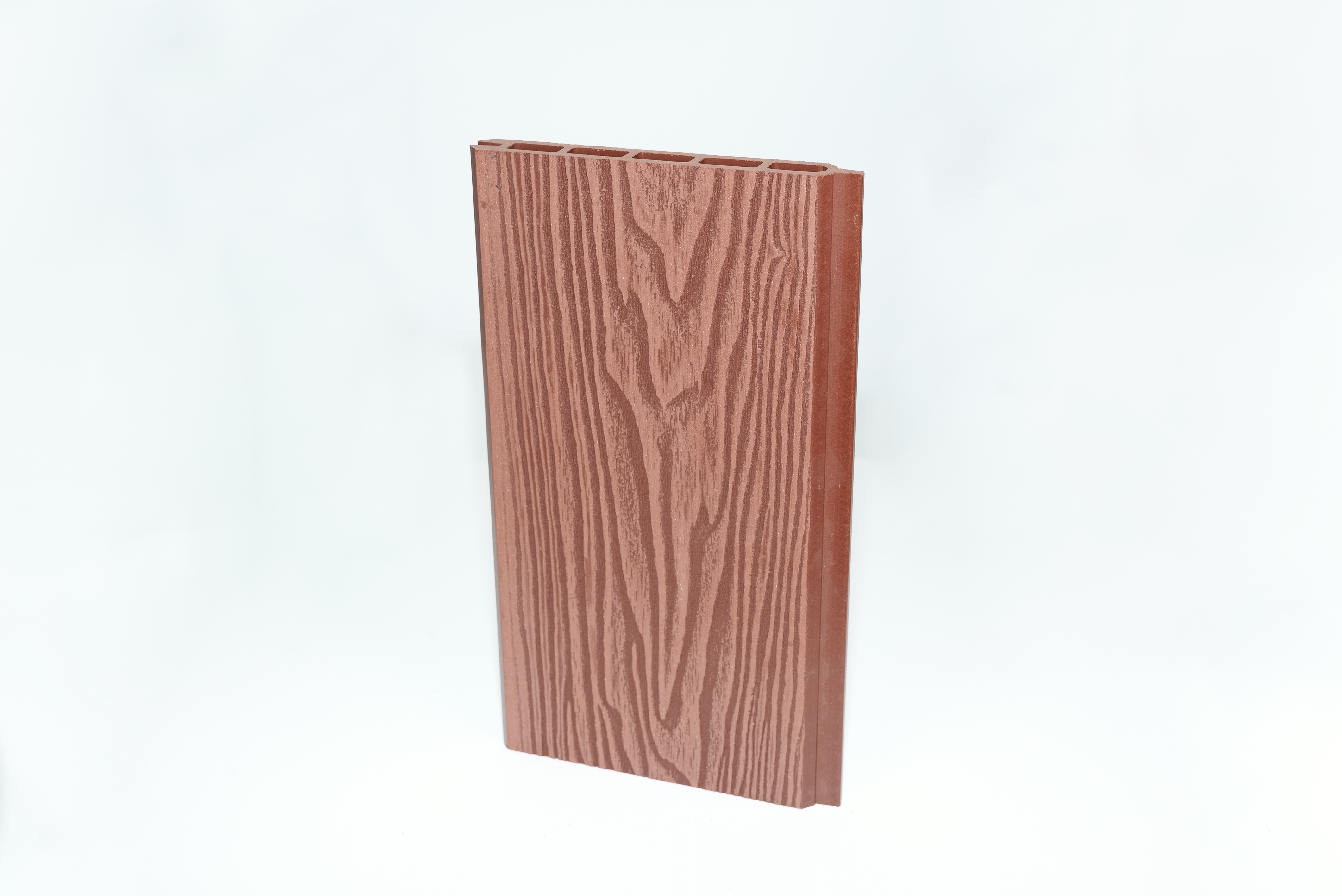
Not all embossing is created equal. To ensure you are getting a high-quality product, you need to vet the manufacturer and the material carefully. It is also worth noting that some high-end manufacturers produce related items, such as a PVC Embossing Fence gate or door, which utilizes similar surface technologies to match the fence line.
A clear warning sign of cheap manufacturing is the "wallpaper effect." This occurs when the embossing pattern repeats every few inches, creating a visible, unnatural grid. Quality manufacturers invest in large, expensive molds that use long-repeat or random patterns. When you look at a row of fence panels, you should not be able to instantly spot the same knot or grain line repeating.
When inspecting samples, use the fingernail test. The embossing should be deep enough to feel distinct resistance when you run your fingernail across the grain. We recommend a depth of at least 0.5mm. If the texture feels barely there, it will likely wear flat within three years of weather exposure.
You must match the fence profile to the embossing depth. A reputable Embossing Fence manufacturer will warn against applying deep embossing on thin-walled hollow boards. Deep pressing on a thin wall can compromise the structural integrity of the board, leading to cracks under wind load. Ensure the board wall is thick enough to accommodate the texture without weakness.
Never buy based on a photo alone. Follow this step-by-step protocol with a physical sample:
Scratch Test: Use a key or coin to scratch the surface. Does it leave a white mark, or does the grain hide it?
Water Test: Pour water on the sample. Does it bead up (good) or soak in (bad)?
Sunlight Inspection: Take the sample outside. Hold it at different angles to ensure the matte finish holds up in direct sun and doesn't turn into a plastic mirror.
While Regular Fence fencing serves a specific niche for ultra-minimalist or budget-constrained industrial projects, it is rapidly being outpaced by modern alternatives. An Embossing Fence offers superior longevity, excellent scratch concealment, and a significant boost in aesthetic value for residential properties. The ability to hide wear and tear within the grain means your fence looks newer for longer.
For the best balance of price and performance, we recommend prioritizing "Deep 3D Embossing" on "Co-extruded" boards. This combination provides the structural protection of a capped core with the visual appeal of premium timber. Before making your final decision, we strongly encourage you to request a texture comparison sample kit to physically feel the difference between flat and embossed finishes.
A: If the board is co-extruded (capped), the fading is minimal. High-quality co-extrusion includes UV stabilizers in the outer shell that protect the pigment. While all outdoor materials mellow slightly, the physical depth of the embossing remains sharp, maintaining the wood look. Cheap, uncapped boards or surface-printed textures will fade significantly faster.
A: It can require a different cleaning approach. While flat fences can be wiped, deep grain textures can trap dirt or pollen. However, they are easily cleaned with a pressure washer (on a low setting) or a stiff bristle brush. The benefit is that the texture hides water spots and minor stains better than a smooth surface.
A: We generally advise against it. WPC boards are designed to be maintenance-free, and their surface chemistry (especially capped polyethylene) does not bond well with standard paints. Painting will likely lead to peeling and will void your manufacturer's warranty. It is better to choose the correct color and texture initially.
A: Yes, typically by a small margin. This is because the manufacturing process is slower; the "Online Hot Pressing" requires precise temperature control and slower extrusion speeds to ensure the pattern locks in. Additionally, the 3D molds are expensive to produce. However, the long-term ROI is often higher due to better durability.
A: It can if the board walls are too thin. This is why it is critical to buy from a reputable manufacturer. They ensure the board's wall thickness is sufficient to support the depth of the grain without creating structural weak points. On solid boards, this is rarely an issue.
