
Please Choose Your Language


Views: 0 Author: Site Editor Publish Time: 2026-07-01 Origin: Site


A deck that looks lighter after a season outdoors is not necessarily suffering from permanent color loss. Dust trapped in embossed grain, mineral marks after rain, mildew in shaded areas, changing surface gloss, and uneven sunlight can all make WPC decking appear faded. The location and texture of the change often reveal more than the color itself. Before using stronger cleaners or attempting repairs, owners need to determine whether the surface is weathering evenly, carrying a removable deposit, or showing localized damage. That distinction leads to safer cleaning, more accurate inspection, and better prevention of future color differences.
The shape and location of a color change on WPC decking usually reveal more than color alone. Mild lightening across boards receiving similar sunlight points toward relatively uniform surface weathering, especially when the finish remains smooth. Dark spotting, cloudy films, rings, or discoloration in embossed grooves more often indicate dirt, water deposits, or biological growth. A sharp line beside a planter, rug, railing, or roof overhang suggests that covered and uncovered areas have different exposure histories. When the boundary matches an object or shade line, the pattern itself becomes evidence.
Board-specific changes require closer attention because they may reflect batch variation, reversed installation direction, contamination, or earlier cleaning. Long pale bands on WPC decking can follow pressure-washer passes, while repeated dark arcs may trace standing water. Rapidly expanding patches are less consistent with normal weathering and should be photographed before treatment.
Inspect WPC decking only after the affected boards are fully dry, since wet wood-grain textures naturally appear darker. Compare gloss, texture, and hardness with nearby unaffected areas under the same light. A matte but smooth finish may have changed mainly in reflectivity, while chalking, loose powder, peeling, cracking, deep scratches, or visible core material indicate a more serious surface problem. Ultraviolet exposure and repeated water cycles can contribute to surface lightening, cracking, and erosion, making texture deterioration a stronger warning sign than color shift alone.
Visible Change | Likely Explanation | First Check | When to Investigate Further |
Mild, even lightening | Weathering or lower gloss | Compare equally exposed boards | The surface becomes patchy or rough |
Grey or brown film | Dust, pollen, or residue | Clean a hidden test area | The dry area remains different |
Rings after rain | Minerals, puddling, or uneven drying | Inspect drainage | Marks repeatedly return |
Green or black spots | Mildew or biofilm | Check shade, debris, and airflow | Suitable cleaning has little effect |
Light and dark strips | Unequal sun, board direction, or cleaning | Match the pattern to site conditions | No exposure pattern explains it |
Chalking, cracking, or peeling | Surface or cap damage | Stop abrasive treatment | Damage affects several boards |
Ultraviolet radiation can alter WPC decking surface chemistry, changing lightness, color intensity, gloss, and the way the boards reflect light. Exposure to both ultraviolet radiation and moisture may create more noticeable surface lightening than dry exposure alone, although the degree of change depends on the material formulation and manufacturing process. On a real deck, those forces are distributed unevenly rather than affecting every board under identical conditions.
Walls, trees, railings, pergolas, furniture, and rooflines divide WPC decking into distinct exposure zones. An open stair tread may receive strong sunlight and dry rapidly, while a sheltered board beside the house stays cooler and damp for longer. Pool surrounds and uncovered edges can experience more frequent wet–dry cycling than protected seating areas. Heat may intensify visible differences, but it should be interpreted together with sunlight duration, moisture, and shade. Reflected heat from walls, glazing, or pale paving can also make a small area behave differently from the wider deck.
Moisture changes the appearance of WPC decking in several ways without necessarily changing the underlying pigment. Evaporating irrigation water can leave pale mineral deposits, recurring puddles can create ring-shaped boundaries, and damp grooves can hold organic matter that supports mildew. Food, grease, rust runoff, pool chemicals, soil, and construction dust create localized marks whose patterns often reveal their source. Because these contaminants collect in embossed grain, a board may look faded from a distance even though its recesses are coated with residue.
Cleaning errors on WPC decking can produce a more persistent difference than the original stain. Strong chemicals may dull the finish, abrasive pads can polish raised grain, and inconsistent pressure washing may leave alternating pale and dark strips. Sanding one section can remove texture or alter gloss, causing the treated patch to remain visible after drying. Each treatment should therefore be tested carefully before it is applied across a larger area.
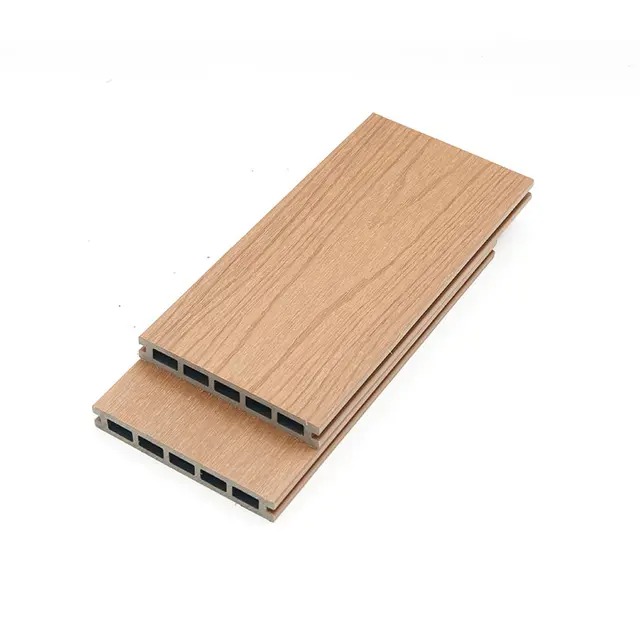
Traditional WPC decking exposes the wood–plastic material directly, while capped or co-extruded products add a protective outer layer. That layer can reduce contact with moisture and contaminants and slow the loss of colored surface components. A hydrophobic cap can also limit photo-oxidation and reduce discoloration compared with an uncapped composite surface.
Protection does not mean immunity. Deep scratches, dragged objects, abrasive pads, or sanding can thin or breach a co-extrusion layer, leaving a spot that reflects light differently. Regular, co-extruded, color-mix, and 3D wood-grain WPC decking surfaces may respond differently to weathering and cleaning, so the exact surface construction should be confirmed before a repair method is selected.
Pigment stability in WPC decking depends on the complete formulation rather than color depth alone. Dark brown or charcoal surfaces may reveal pale dust, scratches, and shade boundaries more clearly, while lighter tones can make grease, mildew, and rust stains more obvious. Mixed-color boards can disguise gradual variation, yet replacing one weathered plank may be difficult because the new piece has a different exposure history.
Small production differences may also become more noticeable after installation. Direct sunlight and long sightlines can amplify minor variation in tone or gloss between boards. Retaining labeled spare material from the original order gives later repairs a better starting point, although stored and installed pieces can still age differently.
Embossed WPC decking creates shadows and highlights, so boards with matching pigment may look different when their patterns face opposite directions. Deep recesses also collect dust and water, making the surface appear darker when wet and greyer when dry. View the area from several angles and under diffuse light before diagnosing true fading. A difference that changes with viewing position is likely influenced by grain direction or gloss.
A controlled WPC decking inspection avoids turning a limited visual issue into permanent uneven discoloration. Begin without strong chemicals, coatings, sanding equipment, or a pressure washer. The aim is to separate removable material from genuine surface change while preserving the original finish. A useful test area should include both raised grain and recessed texture so the result reflects the full board surface. Work across complete boards where possible because spot treatment can create a clean patch surrounded by older residue.
1. Map the affected area and note links to sunlight, shade, drainage, furniture, board direction, or earlier cleaning.
2. Photograph affected and unaffected boards when dry and under similar lighting.
3. Inspect several boards for gloss loss, residue, roughness, cracks, peeling, scratches, or exposed core.
4. Sweep or rinse away loose debris without aggressive scrubbing.
5. Test warm water, mild soap, and a soft-bristle brush in an inconspicuous area.
6. Brush with the grain, rinse completely, and allow the sample to dry.
7. Compare the dry test area with both the affected surface and an untreated board.
8. Review batch codes, retained samples, order records, and installation photographs.
9. Stop treatment and contact the supplier or manufacturer if damage is visible or the discoloration remains unexplained.
Warm soapy water and a soft-bristle brush provide a suitable first treatment for general dirt, debris, mildew, food residue, and some water marks. Cleaning may reveal the original appearance, but it cannot reverse genuine pigment change or rebuild a damaged cap layer. Judge the result only after complete drying, not while the washed area is temporarily darker.
Uniform surface weathering on intact WPC decking may be better monitored than aggressively refinished. Sanding can flatten embossing or remove part of a co-extrusion layer, while metal brushes can leave scratches that catch light. Strong bleach, solvents, incompatible coatings, and uncontrolled pressure washing may create permanent boundaries between treated and untreated boards.
Selective replacement becomes more reasonable when a cap is deeply gouged, peeling, or exposing the core. A new WPC decking board may still differ from older material because its gloss and exposure history are different. Where several boards show spreading chalking, cracking, or peeling, document the condition and request a product-specific assessment rather than repeating stronger cleaning.
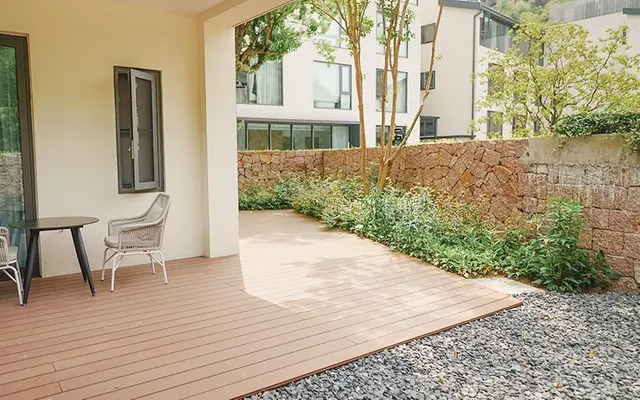
Full WPC decking samples reveal more than small indoor swatches. Place them in direct sun and permanent shade, examine them dry and lightly wet, and view them beside the project’s walls, paving, and furniture. Judge gloss, grain depth, and color variation together because each affects the final appearance. Comparing regular, co-extruded, color-mix, and 3D wood-grain samples before placing a full order can make subtle surface differences easier to identify.
Avoid basing a purchase on an unsupported fading percentage or a general claim that does not identify the exact product. Record which surface construction, color, and batch the sample represents. Co-extruded boards may offer a different exposure barrier from regular composite surfaces, but their caps still need compatible cleaning and protection from deep scratches.
Order WPC decking for the main visible area from one production batch where possible, then inspect and distribute boards before fastening them. Minor tone differences look less accidental when mixed across the deck rather than clustered in one corner. Keep grain direction consistent unless an alternating pattern is deliberate, retain labeled spare boards, and place batch transitions away from prominent sightlines.
Permanent shade from pergolas, walls, outdoor kitchens, and furniture will create different weathering zones, while poor drainage can leave repeated puddle marks. Redirect irrigation and downpipes, maintain airflow, and protect boards from cement dust, paint, metal filings, and soil during construction. These measures cannot stop normal WPC decking weathering, but they reduce avoidable board-to-board and zone-to-zone contrast. Early planning also makes later inspection easier because the original batch, layout, and exposure conditions are known.
Color changes in WPC decking should be judged by their pattern and surface condition rather than appearance alone. Even weathering may only require observation, while dirt, mildew, or mineral deposits call for careful cleaning. Localized fading, chalking, peeling, or exposed core material deserves closer inspection before any aggressive treatment. Zhejiang Kunhong New Material Co., Ltd. offers regular and co-extruded decking in different colors and wood-grain finishes, giving buyers options suited to varying outdoor conditions. Careful product selection, batch control, drainage planning, and compatible maintenance can reduce uneven color differences and preserve a more consistent deck appearance.


