
Please Choose Your Language


Views: 0 Author: Site Editor Publish Time: 2026-09-07 Origin: Site


A terrace can look excellent on delivery day and show visible marks after the first furniture rearrangement. Co-extrusion WPC decking scratch resistance depends on the protective surface, the objects touching it, and the way the space is used. A capped board can improve resistance to everyday marking, but it cannot make sharp metal, trapped grit, or heavy dragged furniture harmless. For buyers, the useful question is how the selected finish performs under realistic contact and how easily any marks can be managed without damaging the cap.
Selection at a glance: evaluate scratches separately from abrasion, dents, stains, and slip performance; compare the actual colour and texture; ask for a documented test method; and approve a furniture-contact sample before ordering. No single hardness label answers all of these questions.
Several different surface changes are commonly called scratches, although they need different responses. A scuff may be transferred material from a shoe or furniture foot. A fine line may be a shallow surface disturbance. A gouge is actual material removal, while a dent is local compression. Cleaning a transfer mark and repairing a cut through the cap are different tasks, so identifying the damage prevents an unnecessarily aggressive treatment.
Begin with the least invasive assessment: remove loose debris, clean the area using an approved mild method, let it dry, and inspect it again under the same light. A wet board can conceal a line temporarily, making a quick inspection misleading. Compare the affected area with an untouched piece rather than judging it against a photograph taken in different weather, at a different angle, or with different exposure settings.
Visible symptom | Likely distinction | First action |
|---|---|---|
Dark or pale smear | Possible material transfer | Use an approved cleaner and reassess after drying |
Fine line without obvious depth | Surface disturbance or shallow scratch | Inspect under consistent light and retain a sample |
Deep groove or exposed core | Material removal through the surface | Ask about replacement rather than routine polishing |
Compressed spot below a foot | Indentation under concentrated load | Review contact area and furniture support |
Broad worn patch | Repeated abrasion | Remove the abrasive source and assess surface loss |
Co-extrusion combines a composite core with a separately formed outer layer during production. In decking, this layer is designed to manage surface exposure and appearance, while the board profile and core remain important to bending behaviour and support requirements. Buyers comparing WPC decking profiles should therefore keep two decisions separate: how well the surface resists contact damage, and whether the complete board is suitable for the planned installation and loading.
The cap is not simply a decorative film whose colour alone defines performance. Its formulation, continuity, thickness distribution, and bond to the core influence how it responds to rubbing and localized contact. These properties vary between products, so the word co-extrusion is a construction description rather than a universal scratch rating. Ask which faces are capped, how the exposed edges are treated, and whether the test sample matches the delivered profile.
For a specific product comparison, ET9204G co-extrusion decking offers a starting point for discussing the intended exposed surface and finish. Choose the exact colour and texture to be supplied, because the visibility of a line can change substantially across finishes. Approving an attractive sample in one colour does not establish the appearance of the same contact mark on every colour available in a product family.
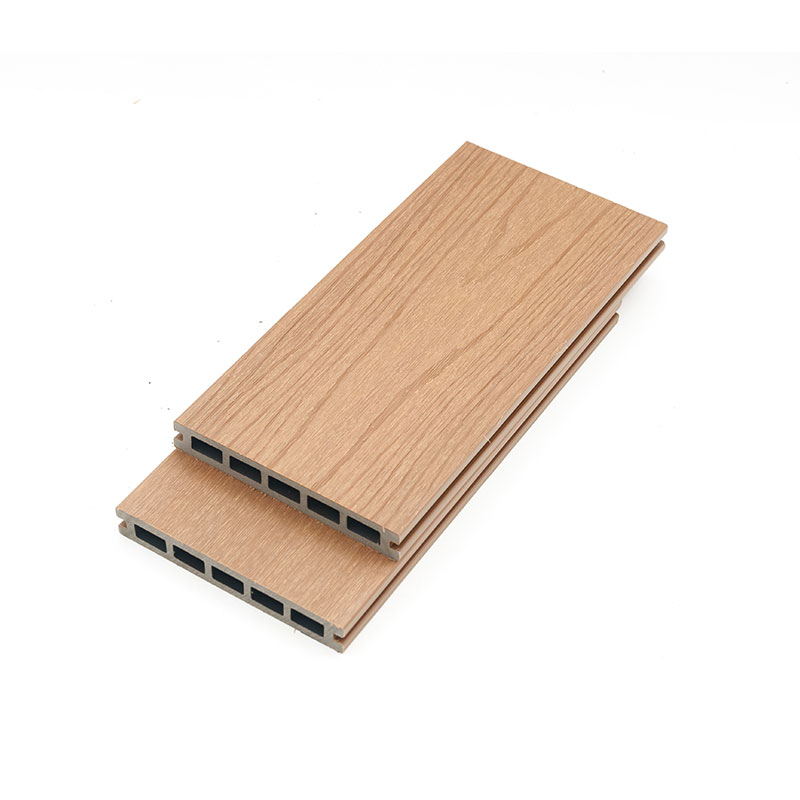
Brown hollow co-extrusion decking sample showing the textured walking face.
A varied wood-grain pattern may make a light line less noticeable, even when the underlying material has the same resistance as a smoother finish. Conversely, a uniform dark surface may reveal a pale mark clearly. This is a visual contrast issue, not proof that one board has lost more material. Assess surface damage and visual acceptance independently, especially for terraces where customers see the floor in low-angle afternoon light.
A deeper texture also needs practical evaluation. It can break up reflections and reduce the visual continuity of a line, but grooves may collect grit that later becomes an abrasive under moving feet. The best surface for a space balances acceptable appearance with realistic cleaning access. A decorative pattern should not become a reason to ignore embedded particles at entrances, beneath tables, or along frequently used walking routes.
Loose sand is often more relevant than ordinary soft footwear because hard particles can sit between two surfaces. A person may step normally while a trapped grain concentrates the contact on a very small area. Repeated traffic can then create broader wear. Sites near gardens, beaches, gravel paths, or construction work should include debris control in the specification instead of relying entirely on a tougher-looking deck finish.
Furniture introduces a different pattern of risk. A narrow damaged foot, exposed fastener, or metal edge can create a line as a chair moves, while a broad intact foot may distribute the same furniture weight more gently. Check the underside of every frequently moved item, not just its total mass. Protective pads should be suitable for exterior exposure, remain attached, and be checked when furniture is moved or cleaned.
Poolside projects should distinguish contact durability from wet-use performance. ET9396G hollow decking can be considered in a decking comparison, but a scratch-resistant description does not establish a slip rating for the installed pool surround. Dirt, water, cleaning residues, board texture, and barefoot use create a separate assessment. Neither a clean scratch sample nor an attractive product image should substitute for the evidence required for the actual walking environment.
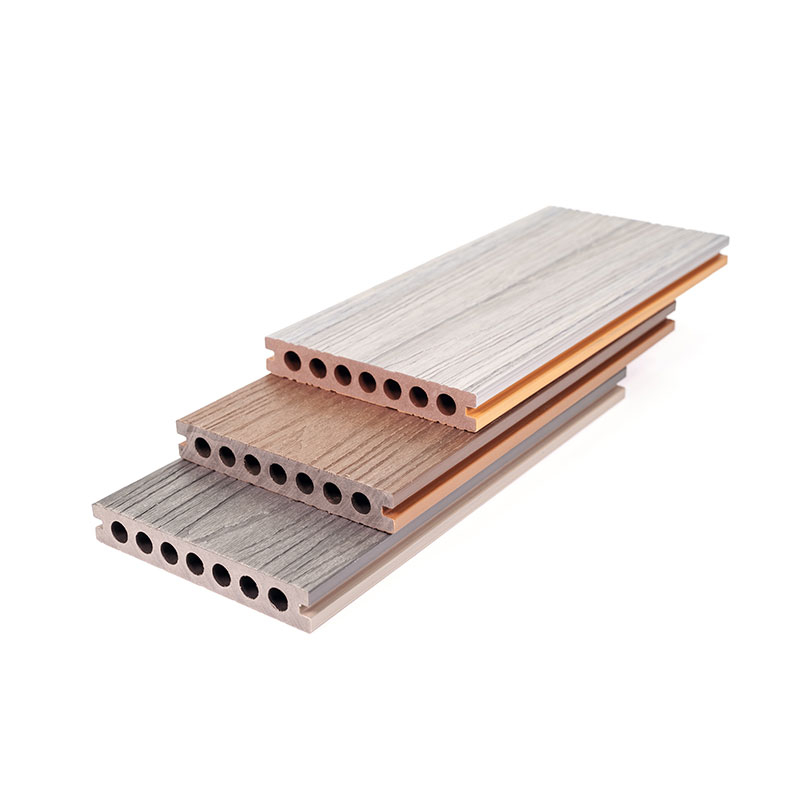
Hollow decking sample illustrating why contact finish and board construction need separate checks.
Temporary construction traffic can be harsher than the deck's eventual daily use. Toolboxes, ladders, loose screws, and dragged packaging may damage a finished surface before handover. Plan the sequence of trades and use suitable temporary protection that will not trap abrasive debris or retain excessive moisture. Removing protection periodically for inspection is often more useful than discovering scratches only when the completed area is presented to the client.
A meaningful co-extrusion WPC decking scratch resistance comparison needs a defined method, not just a number. Ask for the contact tool or tip, applied load, movement, surface conditioning, and pass criterion. A single scratch, repeated abrasion, and indentation test measure different responses. Results are comparable only when those conditions are sufficiently aligned and the tested specimens represent the same type of finished surface being purchased.
Treat a hardness code cautiously when its scale is not identified. Pencil hardness, mineral scratch hardness, and instrumented polymer tests are not interchangeable descriptions. Even a correctly reported surface hardness does not directly predict a chair dragged across a grit-covered terrace. A credible report should identify the laboratory, sample, procedure, and observations, allowing the buyer to understand what was measured and what remains outside the result.
A small mock-up can supplement laboratory evidence by showing the visual consequences of realistic contact. Use the intended furniture feet and representative clean and contaminated conditions, with a written procedure and comparison sample. Keep this evaluation on sacrificial pieces rather than the finished deck. An informal mock-up is an application screening exercise, not a certified durability rating or permission to extrapolate an untested lifetime claim.
Photograph approved samples before and after evaluation using the same distance, direction, and lighting. Record whether marks remain visible at normal viewing distance as well as under close inspection. For hospitality procurement, decide who approves the appearance and what counts as unacceptable damage before placing the purchase order. This avoids a later dispute in which the supplier judges a faint mark technically acceptable while the property owner considers it visually distracting.
Record clean and grit-contaminated contact trials separately, because combining them into one result can hide the source of damage. Use matched samples and repeat the same movement on each finish. A buyer can then distinguish resistance under ordinary contact from the consequence of poor debris control. Keep these observations separate from the certified test report, with clear labels identifying which evidence is laboratory testing and which is a project mock-up.
Daily care should focus on removing abrasive material before it is repeatedly walked over. Sweep or rinse as appropriate for the approved maintenance instructions, and pay attention to furniture feet and door thresholds. Avoid abrasive pads, aggressive solvents, and improvised polishing treatments unless specifically permitted for the selected cap. A cleaning product that removes one mark may alter gloss or colour and leave a larger visible patch behind.
Do not apply an uncapped-board repair technique automatically to capped decking. Sanding can remove or thin the protective layer and expose a contrasting core, while heat treatment can change the surface in an uncontrolled way. For ET9375E embossed decking, confirm the exact surface construction and written repair guidance before choosing any abrasive method. Product naming alone is not enough to determine whether a particular board face can be sanded safely.
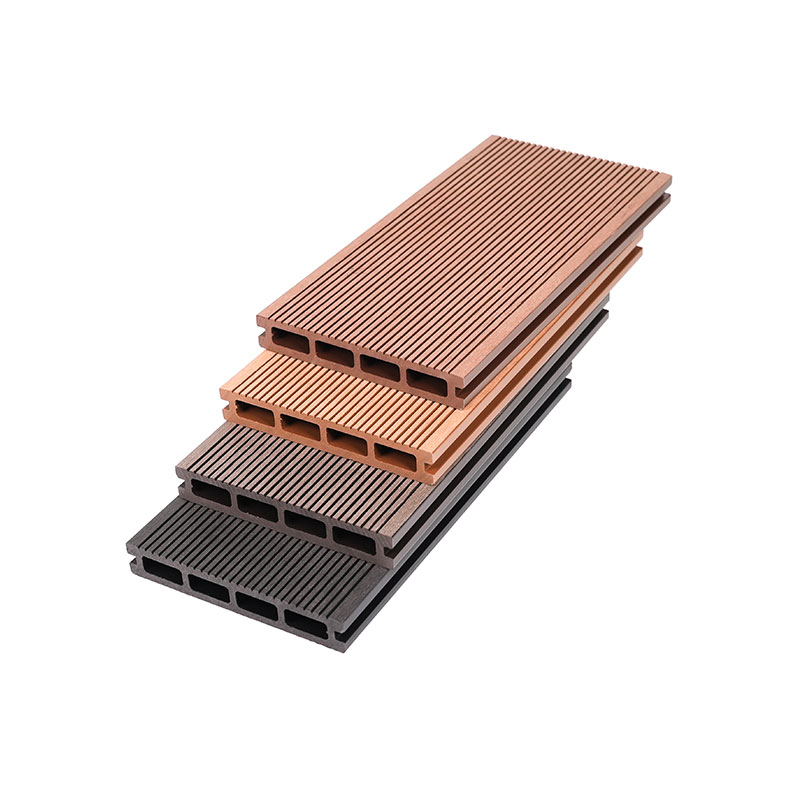
Embossed hollow decking profile with the exposed face and internal cavities visible.
Replacement planning is part of practical scratch management. Ask how an individual board can be removed within the chosen fastening system, and retain an appropriate quantity of spare material from the approved batch. A new board may appear different from weathered neighbours, so consider the location of replaceable sections. Installation access, compatible fasteners, and Decking joist options should be reviewed together without assuming that every support profile has the same structural role.
Entrance planning can reduce the amount of abrasive material reaching the deck. Consider how people move from soil, gravel, or a work area onto the finished surface, and provide a cleaning point or suitable debris-control arrangement where practical. Any mat or protective item should be compatible with the decking and permit appropriate drying. Check beneath it periodically, since an item intended to protect the surface can itself conceal accumulated particles or uneven appearance.
The purchase specification should name the model, finish, contact conditions, test evidence, acceptable appearance, and maintenance restrictions. Include a process for receiving inspection and reporting damage before installation, since transport scuffs should not be confused with wear in service. Keep approved samples available to the installer and property operator so that cleaning and repair decisions remain consistent with the surface originally selected by the buyer.
For a repair decision, ask whether the damage is superficial, through the cap, or associated with deformation of the board. Request a method specific to that condition and establish whether it affects the warranty. If replacement is required, compare the proposed spare with a dry installed board before proceeding. Agreeing on the expected appearance prevents a successful technical repair from becoming an unresolved aesthetic complaint after the work is completed.
Co-extrusion WPC decking scratch resistance is best judged as a combination of verified contact performance, finish visibility, and site care. Zhejiang Kunhong New Material Co., Ltd. is a manufacturer offering composite decking profiles that buyers can assess against these project requirements. Choose a representative finish, distinguish surface protection from structural suitability, and agree on evidence and repair limits before purchase. A well-specified terrace pairs a suitable board with debris control, furniture protection, and a workable replacement plan rather than treating the cap as immunity from every possible mark.


