
Please Choose Your Language


Views: 0 Author: Site Editor Publish Time: 2026-09-25 Origin: Site


Bathroom cabinets can fail at a hinge, drawer runner, joint, or finish even when the sheet material resists moisture well. Selecting PVC foam board for bathroom cabinets therefore requires more than a waterproof label. Buyers need a board grade that suits the cabinet design, reliable hardware connections, cleanable surfaces, and verified performance of the finished assembly. The useful procurement question is whether the proposed sheet, fabrication method, and fittings work together under humidity, splashing, repeated opening, and ordinary storage loads, not whether a loose sample looks unaffected after a quick contact with water.
Procurement priorities: define the cabinet configuration; confirm sheet grade and tolerance; verify hinge and drawer connections; check moisture and cleaner exposure; and approve a complete finished cabinet sample. A moisture-resistant substrate is valuable, but it is only one part of a durable bathroom cabinet.
A bathroom combines high humidity, intermittent splashing, cleaning chemicals, and temperature changes. The severity varies with ventilation, cabinet location, and how water is used around the basin or shower. A vanity beside a frequently splashed basin is not exposed in the same way as a dry storage unit across the room. Write the expected conditions into the material brief so the supplier and fabricator can assess the proposed board and finish against the same environment.
Separate normal moisture exposure from prolonged standing water or an unrepaired plumbing leak. A moisture-resistant board does not make a completed cabinet immune to every water-related problem. Water may reach fittings, adhesives, decorative layers, or wall connections even if the substrate itself remains stable. Plan for accessible inspection, ventilation, and leak correction rather than treating the cabinet material as a substitute for sound plumbing and a dryable installation.
The PVC foam sheet range can be reviewed for candidate material, but the order should identify the specific sheet intended for furniture fabrication. Ask how it will be supplied, finished, and machined for the cabinet design. A category name does not define cell structure, surface condition, or hardware performance. The material brief should therefore include the grade and relevant verification requirements instead of stopping at the generic phrase PVC foam board.
Cabinet requirement | Evidence to request | Assembly detail to check |
|---|---|---|
Moisture exposure | Grade-specific response after relevant conditioning | Joints, plumbing openings, and dry-out access |
Door operation | Hardware retention and representative repeated loading | Hinge recesses, screws, and side-panel connection |
Drawer operation | Runner attachment and loaded drawer behaviour | Fixing positions, engagement, and alignment |
Shelf support | Deflection under intended storage loads | Span, brackets, and support distribution |
Surface cleaning | Finish compatibility with approved cleaners | Edges, seams, and decorative layer adhesion |
Production consistency | Grade identification and dimensional tolerances | Sample approval and batch inspection |
Foam sheets with similar thickness can have different stiffness, surface hardness, density, and internal structure. Those differences matter where hardware loads are transferred into the board. A soft or unsuitable substrate may behave poorly around a fastener even though it looks acceptable as a loose panel. Compare the actual proposed grade using representative connections, and avoid approving one material sample while leaving the factory free to substitute another grade with the same nominal thickness.
Density is useful for identification and comparison, but it should not become the sole acceptance criterion. The skin, core, and local machining determine how the board behaves at a hinge recess or screw hole. Request the material properties relevant to the design, then verify the finished connection. A heavier panel can also increase door and drawer forces, so selecting a denser board without reviewing the hardware may create a different weakness in the assembly.
Moisture-resistant furniture sheet is relevant to furniture-material selection, and its intended sheet specification should be confirmed for the proposed bathroom cabinet. Agree on thickness, tolerance, finish, and any required protective surface before ordering. Treat this as a board selection, not a claim that complete cabinets or every fitting are supplied with it. The fabricator still needs to demonstrate that the selected material works in the actual cabinet configuration and manufacturing process.
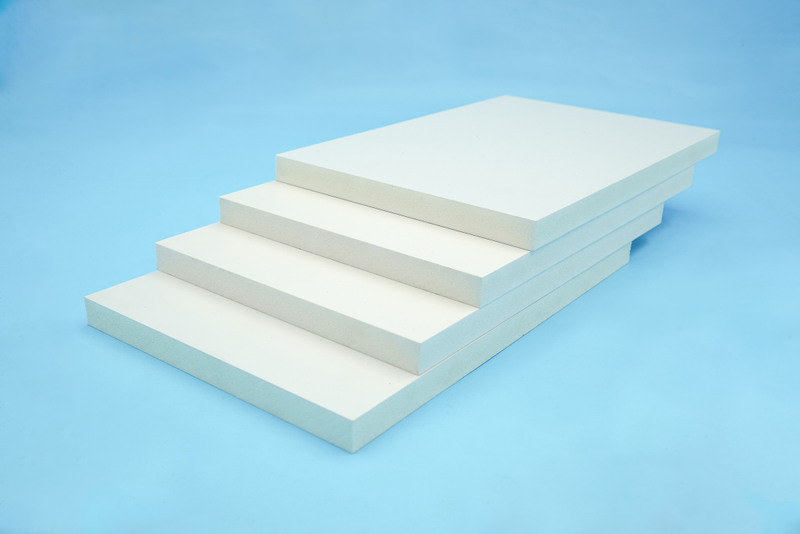
White PVC foam sheet stack used as the substrate for furniture-material evaluation.
Inspect cut samples for consistent thickness, surface condition, and visible internal defects. Compare more than one location and use a sample large enough to evaluate the relevant component. A small display swatch may conceal flatness issues or variation that affects machining and alignment. Record the approved grade and sample identity so later production checks can distinguish a genuine material change from normal appearance differences between sheets.
A cabinet door repeatedly loads the hinge screws and surrounding material. Door size, mass, opening angle, hinge arrangement, and user handling all affect that connection. Evaluate the complete door mounted to the intended cabinet side, not only the hinge on a small offcut. A connection that survives one firm pull may still loosen or change alignment under repeated opening, so representative cycle testing is more informative than an isolated demonstration of initial grip.
Machined hinge recesses remove material and may place screw loads close to a reduced section. Confirm recess depth, edge distance, and the remaining board thickness around the hardware. Follow a fastening method suited to the selected grade, including appropriate screw selection and installation control. Do not assume a fixing method developed for plywood or another material will behave identically in PVC foam board without a connection trial.
Drawer runners create another repeated-load condition. The drawer and its contents transfer forces through the runner fixings into the cabinet sides, with changes during opening and closing. Test the loaded drawer in the actual carcass, checking smooth movement, alignment, and the condition of fixing points. A good runner mechanism cannot compensate for an unsuitable board connection, and a suitable sheet does not eliminate the need for correctly positioned and installed hardware.
Shelf supports should be evaluated with the planned clear span and stored load. Bottles, towels, and cleaning products do not always distribute evenly, and a long shelf may need intermediate support. Consider sustained deflection as well as initial appearance. The shelf, bracket, cabinet side, and joint should be checked together so the selected board is not blamed for a problem actually created by inadequate support or an unverified attachment.
The back panel and joints can influence squareness and resistance to racking. A cabinet that starts square may lose alignment if the connection arrangement does not maintain its shape in use. Specify the bracing role of the back and the method of attaching it, particularly where plumbing openings remove part of the panel. Check the completed carcass after machining and assembly instead of relying on the stiffness of an uncut full sheet.
Countertop and basin loads also need an appropriate path through the cabinet or separate supports. Do not assume that moisture resistance proves suitability for carrying a heavy top or supporting a wall-hung assembly. The completed design must match its installation and loading requirements. Keep the support arrangement, attachment locations, and component specifications in the approval drawing so the installer does not improvise a different load path on site.
PVC sheet water resistance is relevant background when considering bathroom exposure, but the practical selection should use evidence for the exact grade and complete finish. Ask what moisture test was performed, how the sample was prepared, and what changed afterward. Avoid treating an unqualified waterproof label as a guarantee of zero absorption, zero movement, or unlimited immersion. Define the intended exposure and the acceptable response in terms the supplier and fabricator can verify.
The surface finish can be the limiting part of an otherwise suitable panel. Decorative film, laminate, coating, and adhesive must remain compatible with moisture and normal cleaning. Inspect seams, corners, cut edges, and plumbing openings where the finish changes or ends. A stable substrate does not automatically prevent an adhesive bond from weakening or an edge treatment from lifting, so include these details in the completed cabinet sample approval.
Cleaning compatibility should be established with the actual finishing system. Bathroom cleaners can vary in formulation, and a product suitable for ceramic or glass may not be suitable for a decorative polymer surface. Agree on approved cleaners, contact conditions, and routine care instructions. Validate the finish where repeated wiping or splashing is expected, then provide those instructions to the cabinet operator so maintenance remains consistent with the tested construction.
Visible biological growth can occur on dirt or residue even when the board does not behave like a moisture-sensitive wood panel. Cleaning access, ventilation, and the removal of persistent leaks remain important. Avoid promising that a material choice alone makes a bathroom cabinet permanently mold-free. A realistic design lets users reach vulnerable areas and wipe surfaces without damaging the finish, while keeping enclosed spaces from becoming difficult-to-inspect moisture traps.
The wider PVC foam board applications helps place cabinet use within the material's possible applications, but a finished bathroom cabinet needs its own validation. Produce a sample with the ordered board, machined features, hardware, joints, and decorative treatment. Evaluate fit, flatness, opening behaviour, stored loads, and relevant moisture exposure. Keep the acceptance record linked to the bill of materials so the approved assembly can be reproduced rather than loosely imitated with similar-looking components.
A useful validation sequence starts with dimensional and visual inspection, followed by representative operation and load checks, then relevant conditioning and reassessment. Examine screw points, joints, finish edges, and alignment after the evaluation rather than only at the beginning. Establish the test programme and acceptance limits with the responsible parties before testing, since a result has little procurement value if nobody agreed what change would count as unacceptable.
For batch orders, require identification of the board grade and approved hardware, plus a procedure for substitutions. Check thickness, flatness, machining accuracy, and finished appearance at representative stages. A material change that seems minor can affect screw retention or adhesive behaviour, while a hardware change can alter loads on the same board. Maintaining the approved specification across batches is therefore as important as selecting a promising material during the first sampling round.
Compare quotations on the same finished-cabinet requirements. Include board grade, component dimensions, finish, hardware, validation scope, inspection, and packaging rather than focusing only on sheet price. The cost of rejected doors, loose runners, damaged finishes, or site rework can exceed a modest material saving. A clear procurement schedule makes it easier to identify genuine differences between offers and to understand which verification work is included in the quoted supply.
PVC foam board for bathroom cabinets should be selected through a combination of moisture performance, furniture-grade behaviour, reliable connections, and a compatible finish. Zhejiang Kunhong New Material Co., Ltd. is a manufacturer offering PVC foam sheet products that can be assessed for these requirements through confirmed specifications and representative samples. Approve the finished cabinet with its real hardware and supports, retain the material identity, and keep maintenance instructions clear. This approach addresses the places where cabinets actually experience repeated stress and exposure, making moisture resistance part of a complete material decision rather than the only deciding claim.


