
Please Choose Your Language


Views: 0 Author: Site Editor Publish Time: 2026-09-18 Origin: Site


A decking board does not have one usable load capacity independent of its installation. WPC decking performance depends on the profile, material behaviour, support spacing, temperature, loading pattern, and fastening arrangement. A short laboratory specimen can carry a load that a longer unsupported board cannot carry with acceptable deflection. Buyers therefore need a rated installation configuration rather than a headline number alone. For a terrace, walkway, or pool surround, the board and the supporting structure must be checked together while keeping decorative trims separate from the walking surface.
Engineering brief: identify the required distributed and concentrated loads, the allowable deflection, the board orientation, the support spacing, and the service environment. Then obtain evidence for the exact profile and fixing system. Do not convert an isolated breaking load or a mass-per-area claim into an approved design load.
A uniformly distributed load and a concentrated load stress a deck differently. People spread across a terrace create one pattern, while a heavy planter resting on small feet creates another. Furniture, maintenance equipment, and access routes may add cases that ordinary pedestrian use does not describe. Establish the project requirements before choosing a board, because a product intended for one type of use cannot be assumed suitable for every heavier or more concentrated application.
Strength is only one acceptance limit. A board may avoid breaking yet deflect enough to feel uncomfortable, disturb joints, or affect drainage. Serviceability requirements therefore need to be identified alongside ultimate resistance. Ask what deflection criterion was used in the submitted evidence and whether it applies to the proposed span. Without that information, a high test load may describe survival under a test rather than satisfactory performance in normal service.
When reviewing the WPC decking range, create a schedule that links each shortlisted profile to its intended application and supporting arrangement. Include whether it will be used horizontally, on stairs, or around an edge. These uses can require different evidence and detailing. A product family name is useful for browsing, but the actual engineering decision must refer to a specific board section and the configuration in which it has been evaluated.
A claim in kilograms per square metre expresses mass per area, while structural specifications may state force per area, a concentrated force, or a span rating under defined conditions. These descriptions are not interchangeable without context. A quoted figure must identify the span, supports, loading arrangement, temperature, duration, and acceptance criterion. If those details are missing, ask for the underlying report instead of treating the marketing figure as a complete design specification.
Similarly, a material bending strength is not the allowable load of a completed deck. It describes a specimen response under a particular test and must be interpreted with geometry and design conditions. Board capacity cannot be obtained by copying that strength into a purchase order. The responsible designer needs appropriate performance data, relevant reduction factors, and the actual load path through boards, supports, connections, and the building structure.
The outer dimensions, internal cavities, wall thicknesses, and orientation of a board influence its resistance to bending. Two hollow profiles of the same nominal width and depth can have different stiffness because material is distributed differently within the section. A solid board may offer different behaviour, but it cannot be ranked above every hollow board without comparable test conditions. Examine the section drawing and the evidence together, particularly where screw or clip grooves reduce local material thickness.
Solid composite deck boards provides a relevant solid-board option for comparison, but the comparison should still use the proposed support spacing and load cases. Check nominal dimensions, dimensional tolerance, and the section actually supplied. A visual sample can show colour and texture while concealing a small geometry difference that affects fit or support. Keep the approved drawing with the order so receiving inspection has a reference beyond the appearance of the board face.
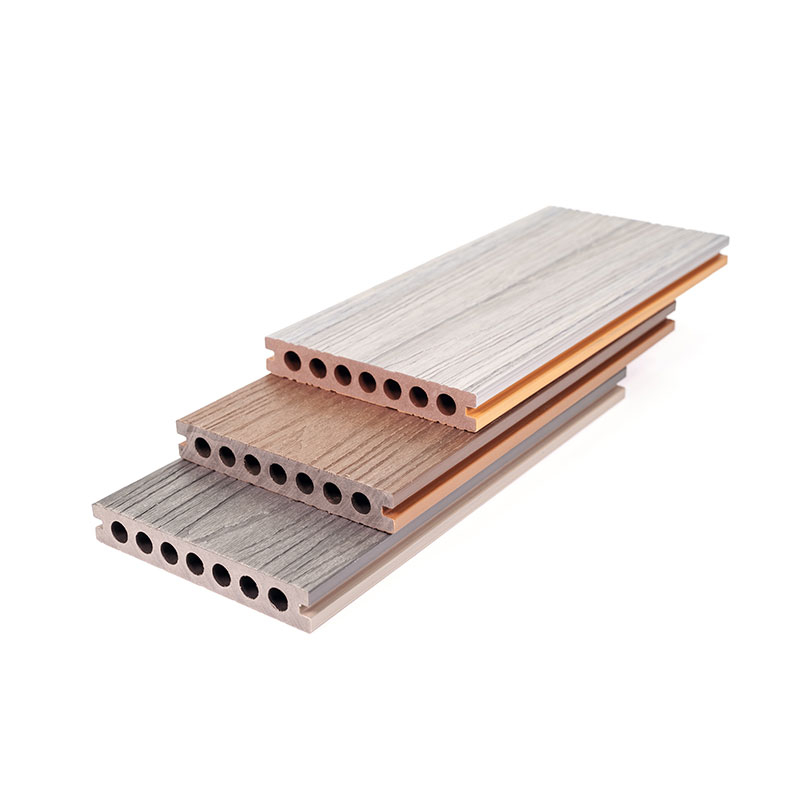
Hollow decking section showing cavities that influence the distribution of material.
Local contact pressure deserves its own review. A narrow furniture foot can compress the exposed surface even when the board's overall span is acceptable. Conversely, a board that resists indentation can still bend excessively between supports. Assess concentrated contact, bending, and overall structural support as separate mechanisms. Spreading furniture contact over a larger area may help one mechanism, but it does not automatically resolve an overloaded support or inadequate joist arrangement.
A co-extruded cap mainly concerns the outer surface and should not be used as a shortcut to structural approval. ET9324G dual-colour decking belongs in a decking shortlist as a dual-colour product, but its appearance and cap description do not establish the allowable span. Ask for model-specific load and deflection evidence. When a project needs both a particular colour scheme and higher loading, obtain confirmation of both requirements rather than assuming one follows from the other.
The distance between supports is central to WPC decking performance. Increasing the unsupported span generally increases bending and deflection under comparable loading. Manufacturer guidance should therefore specify the permitted support arrangement for the exact profile and application. Do not increase spacing simply to save framing material, and do not assume that a recommendation for a residential horizontal deck also covers stairs or heavier commercial service without an explicit basis.
Board orientation can alter the effective span. A diagonal layout may create a longer distance along the board between the same supporting members than a perpendicular layout. End joints, perimeter details, and picture-frame arrangements can also need additional support. Review the installation drawing before ordering lengths, because the aesthetic pattern may change the framing requirement and the number of clips, connections, or supported ends needed across the finished surface.
Supports must themselves have a suitable load path. A small sleeper resting on a continuous base and a beam spanning between foundations perform different roles, even if both are casually called joists. Decking joist options can be reviewed when planning a support system, but the selected profile must be approved for its actual role. Confirm bearing conditions, spacing, anchorage, drainage, and whether the support is continuously supported or required to span independently.
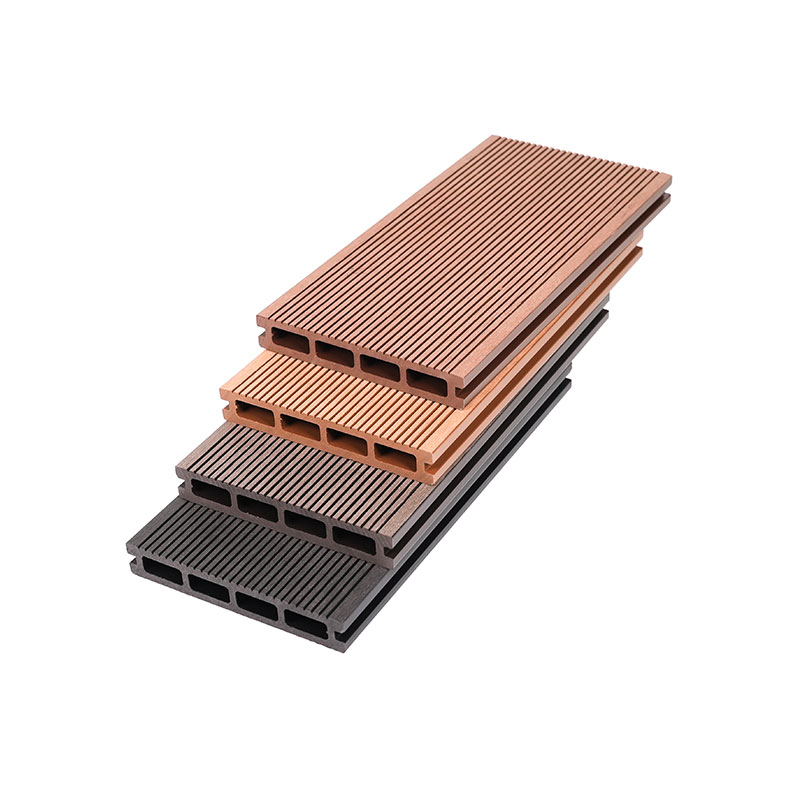
Embossed hollow board profile; section geometry must be assessed with the actual support arrangement.
Connections complete the load path and control movement. Clips and screws need to match the groove, substrate, environmental exposure, and installation instructions. An unsuitable fastener may damage the board locally or fail to provide the intended restraint. At the same time, overtightening can interfere with movement if the system depends on sliding or clearance. Treat fastening details as part of the rated configuration rather than a minor accessory chosen after the boards arrive.
Embossed facade edge boards may be relevant to perimeter appearance or a facade transition, but a decorative edge product should not be assumed suitable as a stair tread or unsupported walking board. The name, shape, and visual match cannot establish that role. Specify decorative pieces separately, identify where they are supported, and ensure they do not become an unintended part of the primary load path when the installation is completed.
Polymer-based composites can respond differently under elevated temperature, so room-temperature evidence should be interpreted against the service environment. A dark board in direct sun may experience conditions different from those of a shaded test specimen. Ask whether the load rating accounts for relevant temperature conditions and what installation limitations apply. An operating-temperature statement alone does not prove that the board retains the same stiffness or allowable load at every point in that range.
Sustained loads introduce creep, which is time-dependent deformation under continuing stress. A heavy planter, fixed storage unit, or permanently placed equipment creates a different concern from a brief pedestrian load. Review the duration as well as the magnitude of the load. If a long-term loaded area is planned, obtain evidence and detailing suitable for that use, including how the load is transferred to the underlying structure rather than only the deck board.
Moisture exposure and weathering can also be relevant to retained performance. The design should not rely solely on a new, dry specimen when the board will remain outdoors through repeated wetting and temperature changes. Ask how the evaluation represents service conditions and whether performance was checked after conditioning. These questions help distinguish a short initial strength demonstration from a rating that is meaningful for the intended installation environment.
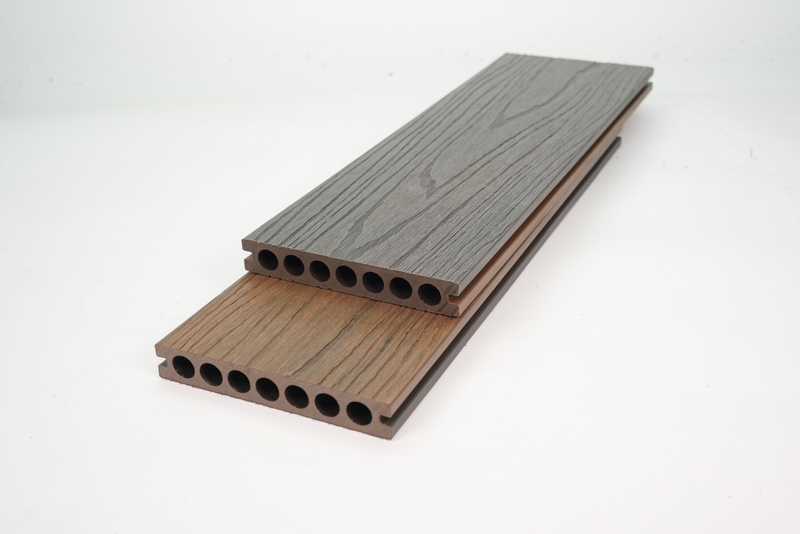
Dual-colour hollow decking sample; finish selection does not replace load and deflection checks.
ASTM D7032 is a specification concerned with establishing performance ratings for wood-plastic composite and plastic lumber deck boards and related products. Its existence illustrates why a board rating is connected to defined end use and test conditions. It does not mean a shortlisted product complies with it. Ask which applicable specification or evaluation basis was used for the actual model, and obtain the corresponding report rather than assuming compliance from a catalogue description.
Document or detail | What it must identify | Why it matters |
|---|---|---|
Section drawing | Exact dimensions, cavities, and fastening grooves | Confirms the profile covered by the evidence |
Load and span evidence | Supports, loading pattern, temperature, and limits | Connects a result to the planned installation |
Deflection criterion | Allowable movement and how it was assessed | Checks serviceability rather than breaking alone |
Installation drawing | Orientation, end supports, joints, and fixings | Avoids unintended unsupported spans |
Support design | Bearing, anchorage, and structural load path | Verifies the system beneath the boards |
Maintenance instructions | Inspection and replacement requirements | Keeps later use within the approved arrangement |
At receiving inspection, compare the supplied boards and fasteners with the approved documents. Record any profile changes, missing identification, visible damage, or substitutions before installation. A test report for one section is not automatically transferable to a revised section or different fastening groove. Batch identification and a retained reference sample help resolve discrepancies early, when replacing an incorrect component is easier than dismantling a completed terrace or walkway.
The installation review should also cover future use. An initially lightly loaded terrace may later receive larger planters, storage, or event equipment. Keep the approved load assumptions in the handover information and require a review before significant changes. Regular inspection should look for unusual deflection, loose connections, damaged boards, and drainage problems, with corrective work based on the complete system rather than only the most visible surface symptom.
WPC decking load capacity is meaningful only within a defined profile, span, environment, and installation configuration. Zhejiang Kunhong New Material Co., Ltd. is a manufacturer offering decking products that buyers can shortlist for project-specific evaluation. Request the actual load and deflection evidence, verify supports and connections, and keep decorative profiles outside the walking-surface approval unless explicitly evaluated for that use. The final decision should connect the required load cases to a complete load path, with clear installation and handover documents that preserve the assumptions on which the selection was made.


