
Please Choose Your Language


Views: 0 Author: Site Editor Publish Time: 2026-11-20 Origin: Site


Sourcing composite decking at scale forces procurement teams to balance aggressive upfront cost reduction with long-term performance and warranty reliability. Volatile raw material costs, varying extrusion standards, and hidden supply chain fees make it difficult for distributors, contractors, and retailers to forecast landed costs and protect profit margins. Procurement professionals navigate a complex web of supplier claims, fluctuating freight rates, and shifting polymer market indices. Stripping away the marketing noise allows you to negotiate contracts based on verifiable production metrics. Understanding the mechanics behind extrusion line speeds, raw material blending, and container logistics gives you the leverage to secure better terms. Evaluating manufacturers based on structural design, material composition, market dynamics, and supply chain stability ensures you protect your margins and deliver reliable products to the job site.
Evaluating Wholesale WPC Decking Boards requires moving past the factory-gate unit price. The true metric for procurement success is the Total Landed Cost (TLC). This equation encompasses the base unit price, ocean freight, import duties, inland transportation, quality assurance testing, anticipated shrinkage, and required installation accessories. Failing to calculate TLC accurately leaves you vulnerable to sudden margin compression. Unexpected port fees or high defect rates materialize upon delivery and destroy your profit.
Chasing the absolute lowest per-board price triggers a cascade of hidden expenses. Low-cost boards frequently suffer from higher defect rates. You will see dimensional instability, premature fading, or core delamination. When these failures hit a job site, the distributor or contractor absorbs the labor costs for tear-outs and replacements. This effectively erases any initial procurement savings. Uncompensated warranty claims destroy profitability faster than high upfront material costs.
Wholesale buyers must adopt an investment mindset. Higher initial procurement costs for premium, capped boards translate directly into long-term maintenance savings and a stronger return on investment. This reliability becomes a powerful marketing tool downstream. Contractors prefer installing materials that do not generate callbacks. Homeowners willingly pay a premium for decks that resist staining and scratching over decades of use.
Scaling up orders exposes buyers to the operational risks of batch-to-batch inconsistency. Manufacturers handling low-tier wholesale orders often alter the ratio of recycled plastics to wood flour depending on spot market availability. This practice leads to severe variations across different production runs. You might receive one container of boards with a rich, dark hue, and a subsequent container featuring a washed-out, lighter tone. Mixing these batches on a single commercial project is impossible. It results in dead inventory.
Structural warping and dimensional variance also plague inconsistent manufacturing. Rushing the extrusion cooling process to increase factory output leaves internal stress inside the boards. Once exposed to sunlight on a job site, these boards twist or bow. They become useless. Consistent dimensional tolerances are non-negotiable for contractors using hidden fastener systems. On a 500-unit multifamily project, a 2mm variance in board width across three containers will completely derail the installation schedule. Installers will fight the hidden fasteners, gaps will look staggered, and the developer will reject the deck.
Establish strict Service Level Agreements (SLAs) before finalizing pricing. These agreements define acceptable defect tolerances, color variation limits, and dimensional accuracy standards. Tie final payment releases to independent pre-shipment inspection reports. This ensures the factory adheres to the agreed-upon specifications and protects you from receiving substandard inventory.
Decking boards represent only a portion of the total material package. The pricing of proprietary hidden fasteners, starter clips, color-matched screws, and fascia boards heavily impacts overall profitability. Many suppliers offer aggressive discounts on the main decking boards but inflate the margins on required accessories. Proprietary grooved boards often require specific clip systems to maintain warranty coverage. You become locked into purchasing these high-margin add-ons.
Evaluate the entire ecosystem. A cheap board paired with an expensive, slow-to-install fastening system costs the contractor more in labor and materials. Analyze the coverage rate of clips per square meter and the cost of matching fascia profiles. This is essential for accurate project estimating.
Significant negotiation leverage exists when bundling decking boards with installation accessories directly from the Composite Decking Manufacturer. Consolidating the purchase reduces logistical complexity. It allows you to demand volume discounts across the entire order. Factories producing their own clips and fasteners have the margin flexibility to lower the overall package cost. This improves your competitive edge in the local market.
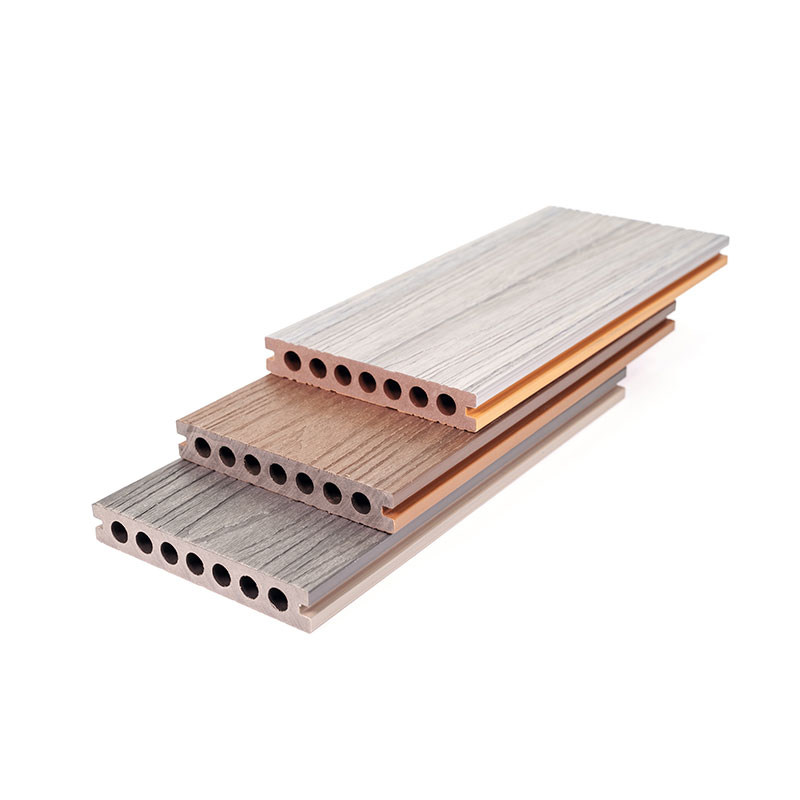
The evolution of composite materials fundamentally altered the wholesale pricing landscape. First-generation, uncapped Wood Plastic Composite (WPC) boards mix wood fibers and polymers into a single, uniform profile. The wood fibers remain exposed on the surface. These boards absorb moisture, grow mold, and fade rapidly under UV exposure. Production costs for uncapped boards stay low due to simpler single-screw extrusion processes and less expensive raw material blends.
Capped boards utilize co-extrusion technology. This process simultaneously extrudes a durable polymer shield around the composite core. The shield contains advanced UV inhibitors, antioxidants, and premium pigments. Operating a co-extrusion line requires sophisticated dual-extruder machinery, precise temperature controls, and higher-grade engineering plastics for the outer shell. These technical requirements increase the base manufacturing cost.
The wholesale premium charged by a Co-extrusion Decking Supplier is justified by field performance. The polymer shield provides superior scratch, stain, and fade resistance. It virtually eliminates the maintenance complaints associated with first-generation boards. Stocking co-extruded products reduces warranty liability for distributors. It aligns with modern consumer expectations for high-performance outdoor living spaces.
The cross-sectional profile of a decking board directly dictates its material volume and wholesale price. Solid boards consume significantly more raw material per linear meter. The extrusion process for solid profiles runs slower. The dense core requires extended cooling times in the water calibration tanks to prevent internal voids or surface warping. High material usage and reduced line speed drive up the unit cost.
Hollow core boards utilize engineered internal channels to reduce material volume while maintaining structural rigidity. Removing mass from the center of the board decreases raw material consumption and accelerates extrusion speeds. The thinner walls cool rapidly. This allows for higher daily production yields. This efficiency translates to a noticeably lower wholesale price point.
Application-based trade-offs dictate procurement choices. Solid boards handle commercial load-bearing compliance, heavy foot traffic areas, and complex installations requiring custom routing or curved edges. Hollow boards offer exceptional cost-efficiency for standard residential markets. A standard 20-foot container maxes out on weight long before it fills up with solid composite boards. Switching to a hollow profile allows you to stack more pallets, maximizing the volumetric capacity and slashing your landed freight cost per board.
| Feature | Solid Core Decking | Hollow Core Decking |
|---|---|---|
| Material Volume | High (100% dense core) | Low (Engineered channels reduce mass) |
| Extrusion Speed | Slow (Requires extended cooling time) | Fast (Thin walls cool rapidly) |
| Wholesale Price Point | Premium | Budget-Friendly |
| Container Yield | Lower (Hits weight limits faster) | Higher (Maximizes volumetric capacity) |
| Best Application | Commercial, heavy traffic, custom routing | Residential, standard decks, budget projects |
Consumer demand for authentic wood aesthetics forces manufacturers to implement complex secondary processing. This adds overhead to the wholesale price. Standard monochromatic boards use a single pigment blend. Advanced profiles require multi-tonal streaking. Secondary colors get injected into the polymer shield during extrusion. Producing Color Mix WPC Decking demands precise calibration. The streaking must look natural rather than repetitive or artificial.
Pigmentation impacts costs directly. High-grade, automotive-quality UV pigments resist fading but cost substantially more than standard industrial dyes. Manufacturers balance the concentration of these expensive additives against the target wholesale price. Darker, richer colors often require higher pigment loads. This marginally increases the production cost compared to lighter shades.
Surface texturing further slows production. Deep 3D wood grain embossing requires the hot board to pass through heavy, engraved steel rollers immediately after extrusion. Wire-brushing techniques create a matte, slip-resistant finish. This adds another mechanical step to the line. Every secondary process reduces the overall extrusion speed. It increases the factory's overhead allocation per board and raises the final wholesale quote.
Manufacturers structure their catalogs into distinct price brackets to capture different segments of the construction market. Entry-level tiers typically feature scalloped bottoms or hollow cores. They pair with basic co-extrusion capping and standard embossing. These lines target budget-conscious residential developments. They compete directly with premium treated lumber.
Mid-range tiers introduce solid profiles, enhanced color streaking, and deeper grain textures. These boards serve the bulk of the custom residential remodeling market. Premium tiers utilize advanced polymer blends, highly realistic matte finishes, and maximum scratch resistance. These flagship products command the highest wholesale prices. They target luxury residential and high-end commercial projects.
Procurement teams must balance their wholesale orders across these tiers. Stocking only premium boards alienates budget-focused contractors. Stocking only entry-level products leaves money on the table when clients demand luxury finishes. A diversified inventory matrix ensures you meet diverse consumer demands. It maximizes inventory turnover and blends your overall profit margins effectively.
The foundation of Composite Decking Wholesale pricing rests on global commodity markets. The core of a WPC board consists of recycled plastics and wood flour or bamboo fiber. The spot market price for post-consumer or post-industrial recycled plastics spikes due to recycling infrastructure bottlenecks or increased demand from other manufacturing sectors. Decking production costs rise in tandem.
Global petroleum prices exert a massive, indirect influence on the industry. The polymer resins used in the co-extrusion capping layer are petrochemical derivatives. Sustained increases in crude oil prices inevitably trickle down to the resin suppliers. They pass those costs onto the decking manufacturers. Monitor energy markets to anticipate upcoming price hikes from your suppliers.
Wood fiber costs fluctuate based on the lumber industry's output. Decking manufacturers rely on sawdust and wood flour generated as byproducts from furniture and flooring mills. If housing starts decline and lumber milling slows down, the supply of wood flour tightens. This drives up the cost of the organic filler used in WPC extrusion.
Broader economic inflation impacts every node of the manufacturing process. Factory labor wages and the electricity required to heat the extrusion dies both increase. During periods of high inflation and robust consumer demand in the housing and remodeling markets, manufacturers operate at peak capacity. This high demand environment reduces the incentive for factories to offer aggressive wholesale discounts. It leads to moderate to high price increases across all product lines.
The pricing elasticity of composite decking is heavily influenced by substitute materials. Pressure-treated pine remains the dominant, low-cost alternative. When lumber prices crash, the price gap between wood and composite widens. Composite manufacturers hold or slightly reduce prices to maintain market share among budget-conscious buyers. When lumber prices spike, composite decking becomes highly competitive. Manufacturers raise wholesale rates without destroying demand.
Cellular PVC decking acts as a substitute at the premium end of the market. PVC contains no organic wood filler. It offers superior moisture resistance but relies entirely on expensive polymer resins. Fluctuations in PVC resin costs dictate the pricing ceiling for premium WPC products. If PVC prices surge, WPC manufacturers gain the headroom to increase margins on their top-tier capped composite lines.
Ocean freight volatility can instantly dismantle a carefully negotiated wholesale contract. Composite decking is exceptionally dense and heavy. Buyers rarely max out the volumetric capacity of a shipping container before hitting the legal weight limit. Container shipping rates, port congestion surcharges, and chassis repositioning fees have a disproportionate impact on the landed cost per square meter.
Inland freight adds another layer of expense. Moving heavy pallets of decking from a coastal port to an inland distribution center requires flatbed trucking or intermodal rail. Fuel surcharges and driver shortages directly inflate these domestic transportation costs. You must factor these into the final wholesale invoice.
International trade policies require constant monitoring. Import duties, anti-dumping tariffs, and countervailing duties add massive percentage penalties to overseas shipments. When vetting an international manufacturer, verify the factory's country of origin and assess the current tariff landscape. Utilizing regional trade agreements or sourcing from countries with favorable trade status protects your wholesale margins.
Factory economics revolve around machine uptime. Minimum Order Quantities (MOQs) exist because shutting down an extrusion line takes hours of unproductive labor. Workers must change the heavy steel die, purge the old polymer colors, and calibrate the new profile. Suppliers structure tiered volume discounts to incentivize large, continuous production runs that maximize machine efficiency.
Standard inventory runs offer the best wholesale pricing. Producing the factory's core colors and standard lengths allows continuous operation. The factory stocks them efficiently and minimizes waste.
Deviating from standard specifications incurs premiums. Requesting custom lengths to minimize job site waste, demanding proprietary color matching, or ordering non-standard profiles requires the factory to absorb setup costs for a smaller batch. Weigh the field advantages of custom orders against the inevitable increase in the wholesale unit price.
Reputable manufacturers carry a heavy financial burden to maintain rigorous international testing standards. Achieving and renewing certifications requires continuous third-party auditing and expensive laboratory testing. Factories must meet ICC-ES standards, CE marking for the European market, ASTM standards for slip resistance, or specific fire-rating classifications.
These compliance costs are baked into the wholesale pricing of certified boards. Sourcing cheaper, non-certified boards from unverified factories introduces severe liability. Installing non-compliant decking on commercial projects or residential balconies results in failed building inspections and forced tear-outs. Devastating lawsuits follow if structural failures occur. The upfront procurement savings of uncertified boards never justify the catastrophic compliance risks.
A 25-year or 50-year warranty is only as valuable as the balance sheet of the company backing it. Analyze the financial stability and operational history of a supplier before committing to long-term contracts. A factory producing co-extruded boards for only three years cannot empirically prove its 25-year fade and stain warranty.
Hidden costs emerge rapidly when dealing with suppliers who lack localized customer service support. If a defect issue arises, poor supplier communication across time zones damages your reputation with local contractors. Demands for excessive documentation and slow replacement cycles frustrate everyone involved. Evaluate a supplier's claims processing history and their willingness to cover replacement labor costs. This is a critical dimension of wholesale supplier vetting.
Quality fade is a notorious risk in overseas manufacturing. A supplier delivers an impeccable first container, but slowly reduces the quality of subsequent shipments to pad their margins. They decrease the thickness of the co-extrusion capping layer. They use lower-grade recycled plastics or increase the ratio of cheap wood flour. Product performance degrades significantly over time.
Implement mandatory third-party quality control inspections to mitigate this risk. Use recognized agencies like SGS or Intertek. These inspections must occur at the factory prior to container loading. Inspectors verify that the current batch matches the approved golden samples in color, dimensions, and weight.
Require batch-testing reports for every shipment. Document critical metrics such as flexural strength, water absorption rates, and boiling tests for delamination. If a batch fails these empirical tests, exercise your contractual right to reject the container before it leaves the port. This prevents substandard material from entering your supply chain.
Relying on a single factory for all wholesale decking inventory is a high-risk strategy. Regional manufacturing shutdowns due to power rationing, local raw material shortages, or shipping lane disruptions instantly halt your operations. Diversifying suppliers across different regions or countries provides critical supply chain redundancy. This ensures continuous inventory flow even during localized crises.
Volatile raw material markets make financial forecasting difficult. Negotiate price-lock agreements for 6-to-12-month procurement cycles to stabilize landed costs. If a hard price lock is impossible due to market volatility, implement raw-material-indexed pricing models. The wholesale price adjusts transparently based on agreed-upon public indices for HDPE and ocean freight. This prevents the supplier from implementing arbitrary, hidden price hikes.
A: Solid composite decking commands a higher wholesale price due to the increased volume of raw materials required and slower extrusion cooling times. Hollow boards use less material and extrude faster, making them more cost-effective. Hollow profiles are consistently positioned as the budget-friendly alternative to solid boards.
A: Co-extrusion requires advanced dual-extruder machinery to simultaneously apply a protective polymer shield over the composite core. This shield utilizes high-grade engineering plastics, UV inhibitors, and premium pigments to provide superior scratch, stain, and fade resistance. The complex manufacturing process and expensive additives justify the higher wholesale cost compared to basic uncapped boards.
A: MOQs dictate factory efficiency. Changing extrusion dies and purging colors requires hours of machine downtime. Suppliers offer better wholesale rates for large, continuous production runs that maximize machine uptime. Ordering below the MOQ or requesting custom lengths forces the factory to absorb setup costs over a smaller batch, resulting in a higher per-unit price.
A: Yes. Producing multi-tonal streaking requires injecting secondary pigments into the polymer shield during extrusion. This demands precise calibration to ensure a natural wood-grain appearance. The use of multiple high-grade UV pigments and the complexity of the blending process increase the manufacturing overhead, raising the wholesale price compared to standard monochromatic boards.
A: Buyers must look beyond the factory FOB quote and calculate the Total Landed Cost. Hidden costs include ocean freight volatility, port congestion surcharges, import duties, anti-dumping tariffs, and inland transportation. High defect rates from cheap suppliers create hidden costs in the form of uncompensated warranty claims and job site replacement labor.
A: No. Non-certified boards pose severe liability and compliance risks. Reputable manufacturers invest heavily in ICC-ES, CE, or ASTM testing to ensure structural integrity and fire safety. Installing uncertified decking leads to failed building inspections, forced tear-outs, and lawsuits if failures occur, completely negating any upfront procurement savings.


